Right2Education at 10: A decade of education, solidarity and community
12 June 2026
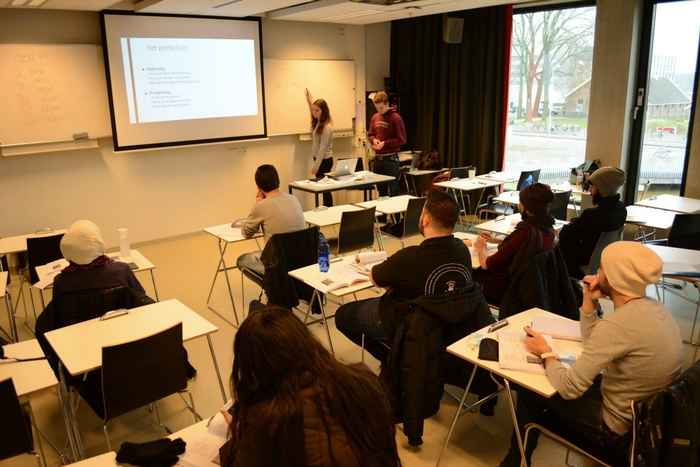
Along the way, it became more than just an initiative; it has become a community built on the belief that access to education should never depend on where someone comes from, and that integration is something created together rather than imposed.
From idea to student initiative
The origins of Right2Education can be traced back to the autumn of 2015, when several AUC students travelled to the Serbian-Croatian border to volunteer with organisations assisting people moving through Europe during a period of large-scale displacement. Based on their experience, they returned with a simple but urgent question: what can universities do to help? At the same time, shelters and support systems for newly arrived refugees were being set up across Amsterdam, and the need for language courses and opportunities for education quickly emerged as critical. Rather than wait for institutional solutions, a group of AUC students decided to act.
Working with AUC faculty, management staff and the Municipality of Amsterdam, the students organised the first Right2Education classes within just a few months. In January 2016, the initiative welcomed its first group of guest students into Dutch language courses at AUC. Some of these first participants joined existing Dutch classes, while AUC student volunteers taught others. The pilot proved successful: more volunteers joined, peer-to-peer classes expanded and lesson plans became more professional.
Within months, Right2Education had grown beyond language education alone. Guest students were auditing AUC courses in subjects such as International Relations, Statistics, Programming and Geological Sciences. By the end of the first year, more than 300 AUC students (roughly one-third of the student body) had participated as teachers, buddies, organisers or volunteers. At the heart of R2E is working with, not for, students. A year in, guest students expressed a desire to learn English and so courses were added at multiple levels to create a broader educational programme that continues today.
Redefining integration
From the beginning, Right2Education aimed to challenge the dominant language and narratives surrounding the so-called “refugee crisis”. Instead of viewing refugees primarily through the lens of crisis management, these students ensured that mutual learning, participation and shared community were the focus. That philosophy is reflected in the language the organisation uses to this day. Participants are referred to as ‘guest students’ rather than refugees or asylum seekers, a deliberate choice intended to emphasise equality and belonging.
Education, however, was never limited to the classroom. One of the initiative’s defining features became its buddy system, which paired guest students with AUC students to encourage connection beyond lessons and coursework. Over the years, the community has organised ice-skating outings, museum visits, movie nights, potluck dinners, picnics, art events and even Arabic language classes created by guest students themselves. Those activities helped shape and showcase Right2Education’s understanding of integration as a two-way process: not something to be imposed on newcomers, but rather something built collectively through interaction, exchange and mutual trust.
Becoming an established organisation
What started as a student-led response quite quickly developed into a long-term institution. Within its first year, Right2Education officially became an NGO with support from the municipality, allowing the organisation to expand its programming and establish a more sustainable structure. Over the past decade, hundreds of volunteers (including students from AUC, the University of Amsterdam, VU Amsterdam, as well as professional teachers) have contributed to the initiative.
They have also continued to create pathways into higher education itself. Through collaborations and scholarship opportunities, some participants have been able to move from language classes into formal university studies, reflecting Right2Education’s broader commitment to educational access and underscoring the importance of continuity and opportunity for all students.
International recognition
Beyond their impact in Amsterdam and the Netherlands, R2E has also received substantial international recognition over the years. In June 2018, Right2Education presented its approach at the United Nations’ #JoinTogether Conference in New York, alongside university initiatives from around the world focused on refugee inclusion in higher education. During the conference, founding board member Ellen Ackroyd spoke about the importance of language education, community building and changing public perception surrounding refugees. The presentation was recognised as the strongest at the conference, affirming the significance of a project that had started only a few years earlier in Amsterdam.
In 2019, R2E was also recognised through the Aurora Diversity and Equality Award as an example of how universities can foster inclusion and civic engagement across Europe. More recently, in February 2026, board members Hanna and Dorina represented Right2Education at the World Youth Forum in Porto. Speaking to an international audience of young leaders, they highlighted how local action and community-driven initiatives can create meaningful and sustainable social change.
Looking ahead
As Right2Education marks its tenth anniversary, the organisation continues to reflect on the same questions that motivated its founders in 2015: who has access to education, who feels welcome within institutions, and how can communities respond to inequality with solidarity rather than exclusion?
Their vision remains centred on equal opportunity and the idea that factors such as nationality, ethnicity, gender, sexuality or migration status should never determine someone’s access to learning. At a time when conversations around migration and integration across Europe remain politically charged, Right2Education’s history offers a different perspective: one grounded not in abstract policy, but at the human level where everyday relationships formed through classrooms, conversations and shared experiences come together to create and enrich communities.
As the next generation of students, teachers, buddies and guest students join the programme, Right2Education continues to show how a local initiative, started with an idea by a small group of students at AUC, can grow into a lasting example of education as a form of solidarity and social change.