
AUC students learn about photography and restitution during visit to NIOD
Course visit connects visual analysis with restitution research
How can a photograph serve as historical evidence? On 10 November, students from Amsterdam University College’s course "The Photograph as Socio-Political Document" visited the NIOD Institute for War, Holocaust and Genocide Studies to explore the role of photographs in historical research and restitution.
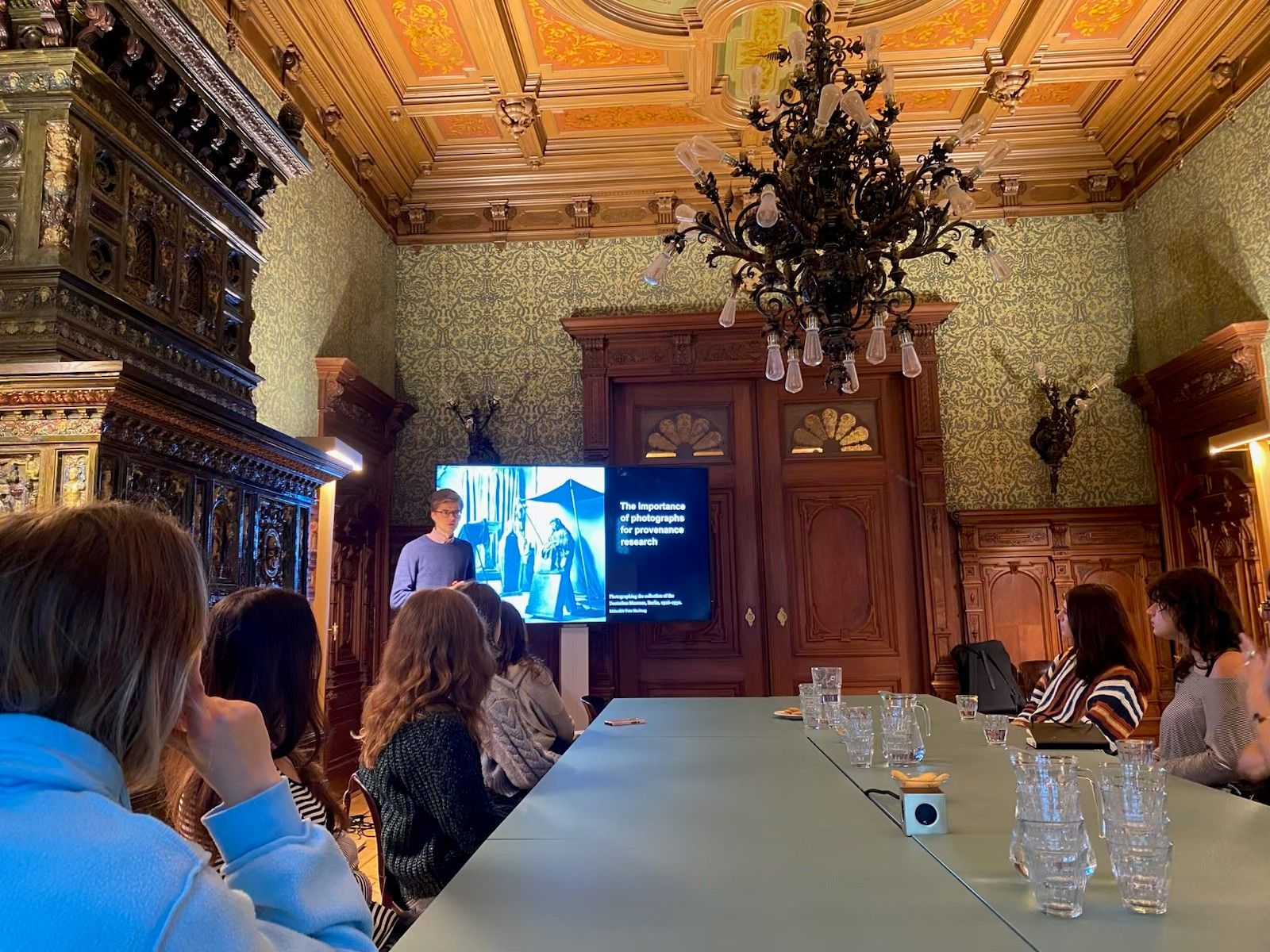
Restitution research and the role of photographs
Organised in collaboration with course lecturer Dr. Janna Schoenberger, the visit began with a welcome from Programme Manager Marije Spek, who introduced the students to the work of NIOD’s Expert Centre Restitution (ECR). The centre conducts independent research into works of art and cultural objects that were lost, looted or otherwise displaced during periods of conflict, including the Second World War, or as a result of colonialism.
Researcher Daniël Hendrikse followed with a presentation on the role of photographs in historical research. He demonstrated how visual analysis can contribute to historical inquiry and offered students insight into how the skills they are developing in the course can be applied in professional research contexts.
Connecting theory with practice
The visit offered students an opportunity to connect the course’s theoretical and methodological approaches to photography with the practical work of researchers. By exploring how photographs can serve as sources of historical evidence, alongside an introduction to restitution research, students gained a clearer understanding of the role visual analysis can play beyond the classroom.
Archives and research at NIOD
The ECR’s work forms part of NIOD’s broader mission to investigate and document the history and societal impact of war, large-scale violence and genocide. The institute also preserves and makes accessible extensive archives and collections, particularly those relating to the Second World War.
Through research, education, digital resources and public engagement, NIOD seeks to deepen understanding of mass violence and its consequences, contribute to public and political debate, and support academic freedom and the rule of law.
More on the course
The Photograph as Socio-Political Document explores how photographs function as historical sources and shape our understanding of social and political realities. Students learn to analyse images formally and critically, questioning their apparent objectivity and examining how their meaning and use are shaped by context, perspective and purpose.
AUC would like to thank Marije Spek and Daniël Hendrikse for sharing their time and expertise with the class.